Captain Phillips and the Maersk Alabama
The Captain Phillips incident began on 8 April 2009, when four Somali pirates boarded the Maersk Alabama and held master Richard Phillips for five days in a lifeboat. SEAL snipers ended it on 12 April.
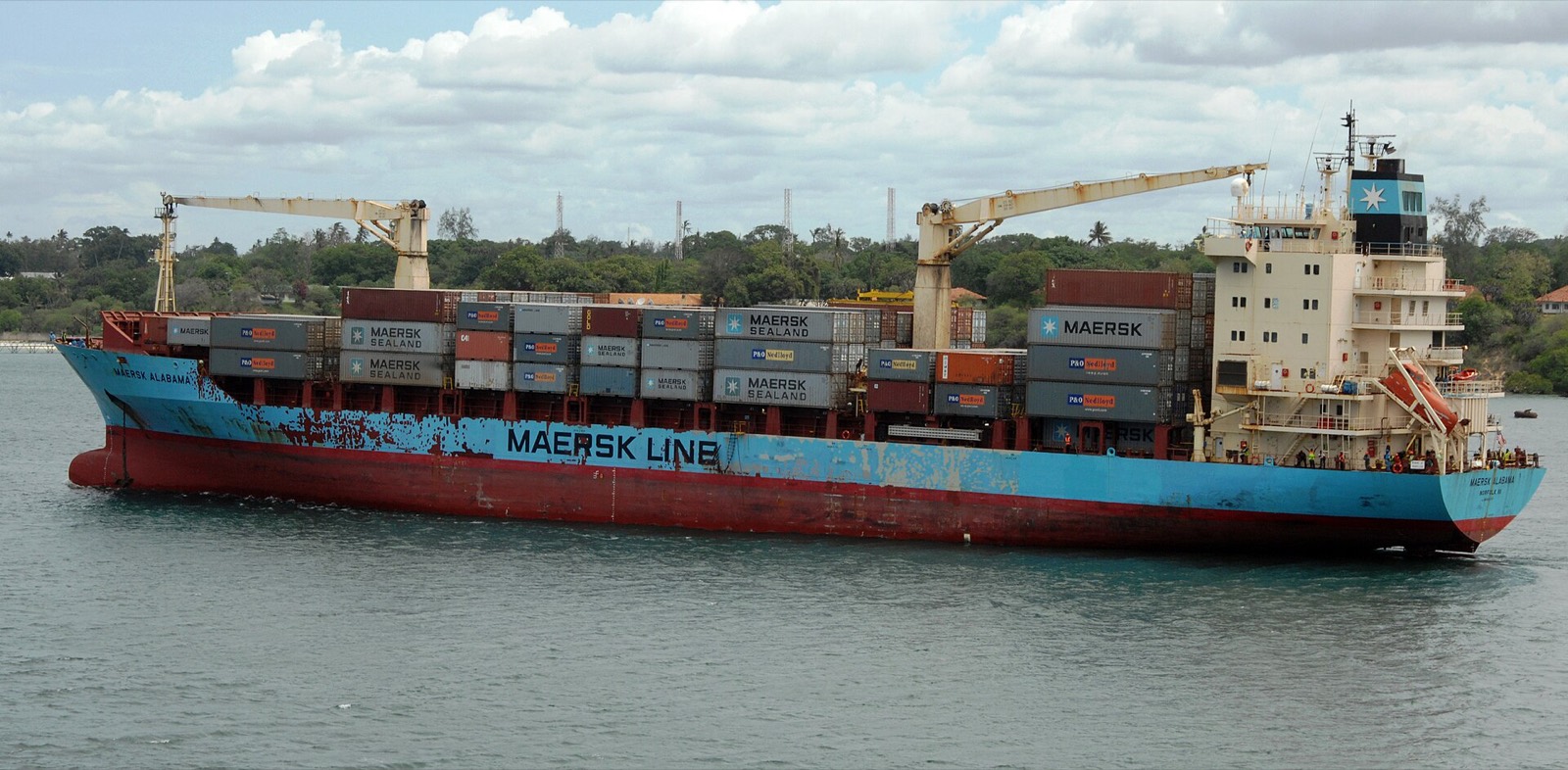
The Captain Phillips incident began on 8 April 2009, when four Somali pirates boarded the US-flagged container ship Maersk Alabama and ended up holding her master, Richard Phillips, for five days in a covered lifeboat. It ended on 12 April, when US Navy SEAL snipers shot the three pirates in the boat. The fourth, Abduwali Muse, was tried in New York. Tom Hanks played Phillips in the 2013 film, and part of the crew disputed both the film's picture of the captain and the route the ship had taken, suing the companies that owned and manned her.[1][8]
The Ship, the Master and the Voyage from Salalah
China Shipbuilding Corporation built her at Keelung, Taiwan, in 1998 as the Alva Maersk: 155 metres long, 17,375 dwt, 1,092 TEU. In 2004 she became the Maersk Alabama and moved from the Danish to the US flag, with Norfolk, Virginia as her home port.[2] Maersk Line Limited owned her and Waterman Steamship Corporation supplied the crew.[1][15] With the US as flag state, a boarding was a matter for Washington directly.
Phillips was born on 16 May 1955 in Winchester, Massachusetts. He started at the University of Massachusetts with international law in mind, moved to Massachusetts Maritime Academy and graduated in 1979, driving a taxi in Boston while he studied.[3] He had relieved Larry Aasheim as master only eight or nine days before the attack.[1][3]
The ship was running from Salalah in Oman to Mombasa in Kenya, with a Djibouti call also recorded. Roughly 17,000 tonnes of cargo included food aid containers for USAID, the World Food Programme and relief charities.[1] Sources put the crew at anywhere from 20 to 23. There were no armed guards.[15][21] The crew had anti-piracy training, and according to Wikipedia's account they had drilled the day before.[1]
Where Somali Piracy Came From
Somalia had no working central government after 1991, and so no coastguard. Foreign trawlers moved into the gap. In 2012 Prime Minister Abdiweli Mohamed Ali blamed illegal fishing and toxic dumping for the rise of piracy, and a convicted pirate, Farah Ismail Eid, gave the same reason. The same report describes Eyl as a fishing harbour turned pirate capital.[6]
That explanation has its critics. The Polish researchers Duda and Szubrycht, writing in 2009, recorded the fishermen's grievances but found that only a small fraction of traditional fishermen had turned to piracy and that fishing was not the main cause; ransom was what drove it.[7] The International Maritime Bureau's numbers show a business growing fast. Somali pirates targeted 111 ships in 2008 and hijacked 42. In 2009 that rose to 217 incidents and 47 hijackings, with 867 crew taken hostage.[5] The longer history is in our piece on maritime piracy.
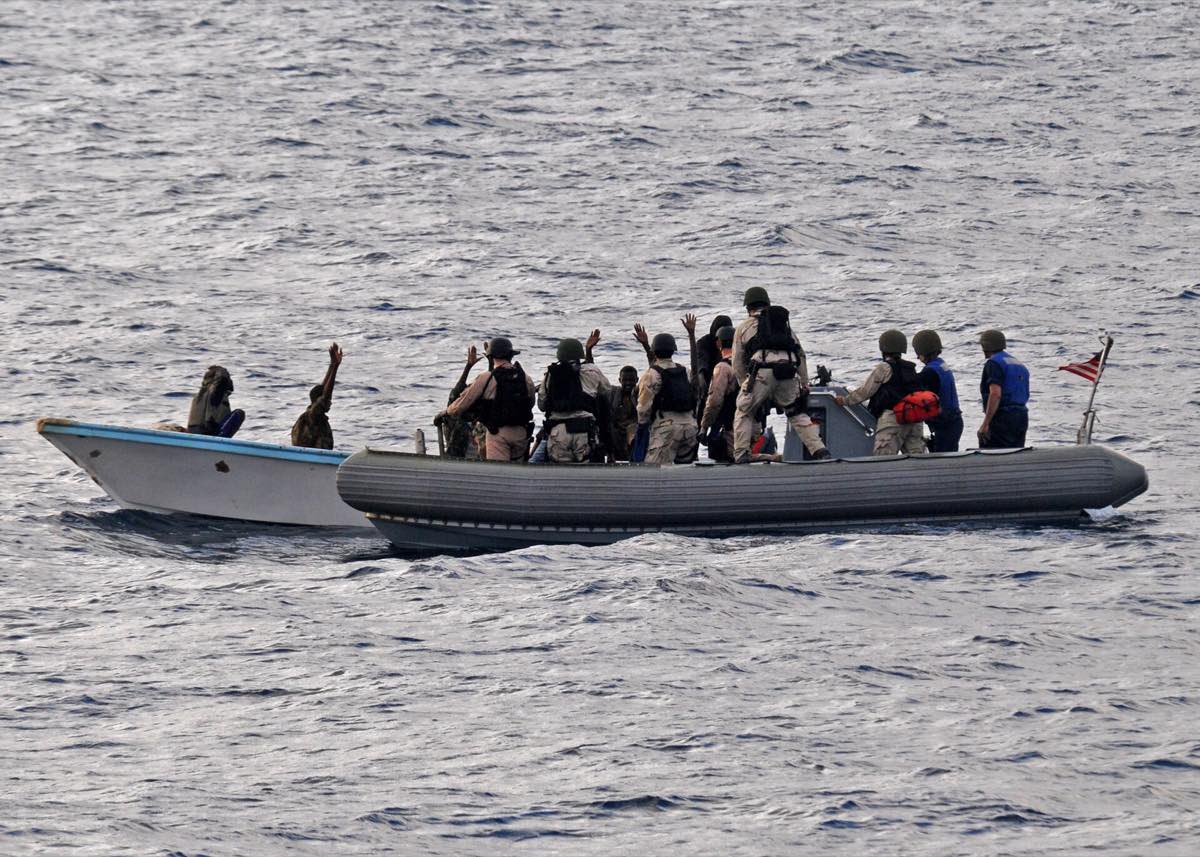
In 2008 the attacks were concentrated in the Gulf of Aden. In 2009 ships off the east coast were increasingly targeted. The IMB logged no attempts there in January and two in February, then 15 in March. The tankers Nipayia and Bow Asir were taken more than 300 nautical miles off Mogadishu on 25 and 26 March. On 31 March the IMB told ships not calling at East African ports to stay as far off the coast as reasonably practical, without naming a distance. Nine ships and 153 seafarers were being held at that point.[4][5] The Maersk Alabama, bound for Mombasa, was heading into those waters.
The Raid of 8 April 2009
The crew's lawsuit says the ship was told to stay at least 600 miles off, and History.com says the US government gave the same advice.[8][17] Pirates had already tried to board her twice that week, and both times she outran them.[15] On the morning of 8 April she was about 240 nautical miles southeast of Eyl.[1]
Four pirates with AK-47s came in a small skiff launched from the fishing vessel Win Far 161, itself held by pirates as a mother ship.[1][13] The crew fired flares. Chief engineer Mike Perry and first assistant engineer Matt Fisher swung the rudder and swamped the skiff, but the pirates still got aboard and went straight for the bridge. Phillips and two others were captured within minutes.[1][9] Pirates had last seized a US-flagged ship in the 1820s by History.com's reckoning; Yankee magazine says the early 1800s.[8][9]
What the Crew Did
By the time the bridge fell, most of the crew had vanished. Perry had taken 14 people to a fortified secure room. He then cut main engine control from the bridge, Fisher took the steering gear, and Perry shut down every system until the ship went dark. The pirates held the bridge and could not move the ship.[1]
Phillips told Yankee he refused to give the code word that would have called the crew up and kept a radio microphone open so the bridge could be overheard. The pirates searched cabin after cabin, but the men had moved to a backup room.[9] When the leader, Abduwali Muse, went down into the black engine room, Perry, armed with a knife, caught him. Muse's hand was cut and second mate Ken Quinn dressed it.[1]
With each side holding a hostage and the crew spending hours in the heat of the sealed room, a swap was arranged: Muse for Phillips. The pirates would leave, and Phillips would show them how to work the lifeboat and be released. It failed. Once in the boat the pirates refused to give Phillips up, and Muse rejoined them. They took $30,000 from the ship's safe, which was never found.[1][9][12]
Five Days in the Lifeboat
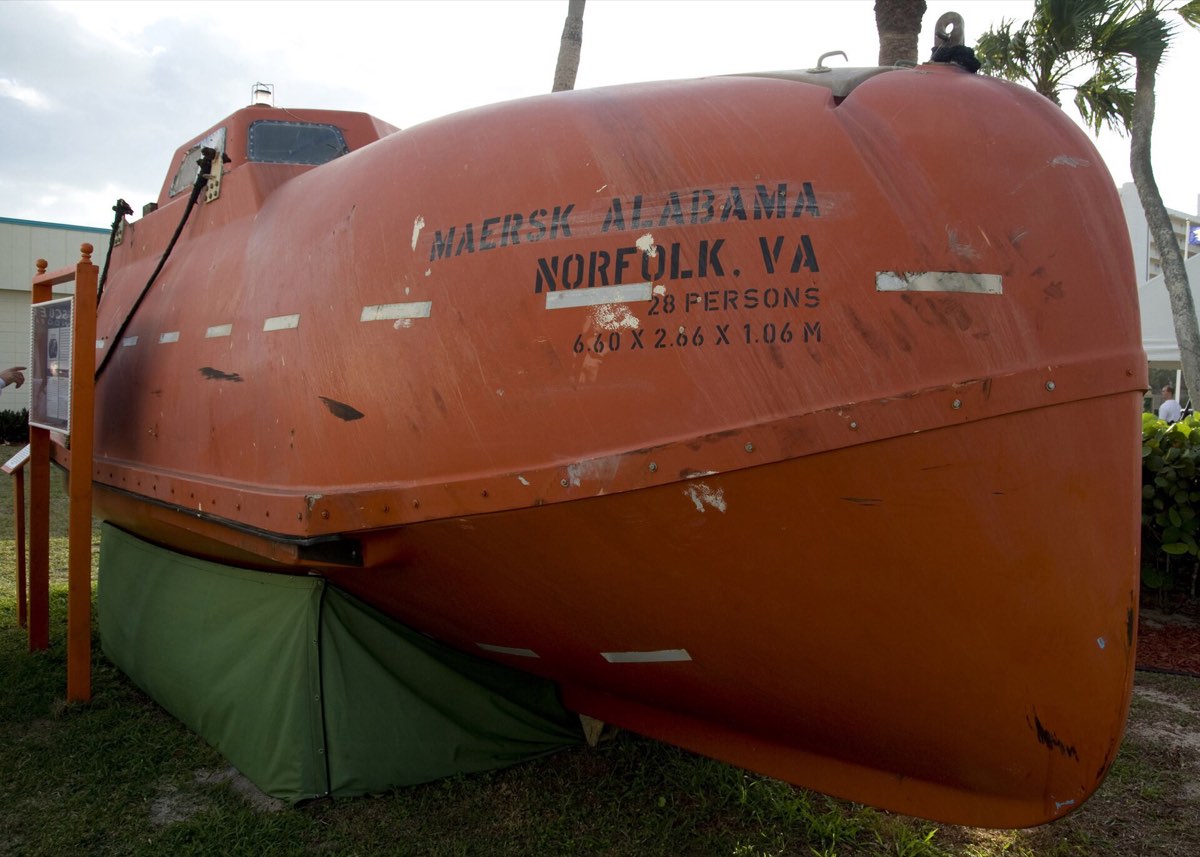
It was the standard enclosed type, marked on the hull as a 28-person boat, 6.60 metres long. There was food and water aboard, no toilet and no ventilation.[1] Phillips told NPR in 2010 that the pirates broke out two windows after the first day, and that the engine, running without a break, made the deck too hot to stand on. Within hours he was down to trousers and socks.[11]
He tried to get away. The SEAL museum dates this to 10 April and says the pirates fired their AK-47s as he swam for the Bainbridge. In the Yankee account he pushes one pirate into the water, dives, covers about 15 metres, is spotted in the moonlight and gets caught holding on to the boat's cooling tubes.[9][10] He told NPR he was beaten and tied up, and that when they threatened to kill him he said silent goodbyes to his family.[11] Wikipedia reports that Phillips later said the 10 April shooting was not an escape attempt, so the sources do not line up neatly on the date.[1]
USS Bainbridge and the Standoff
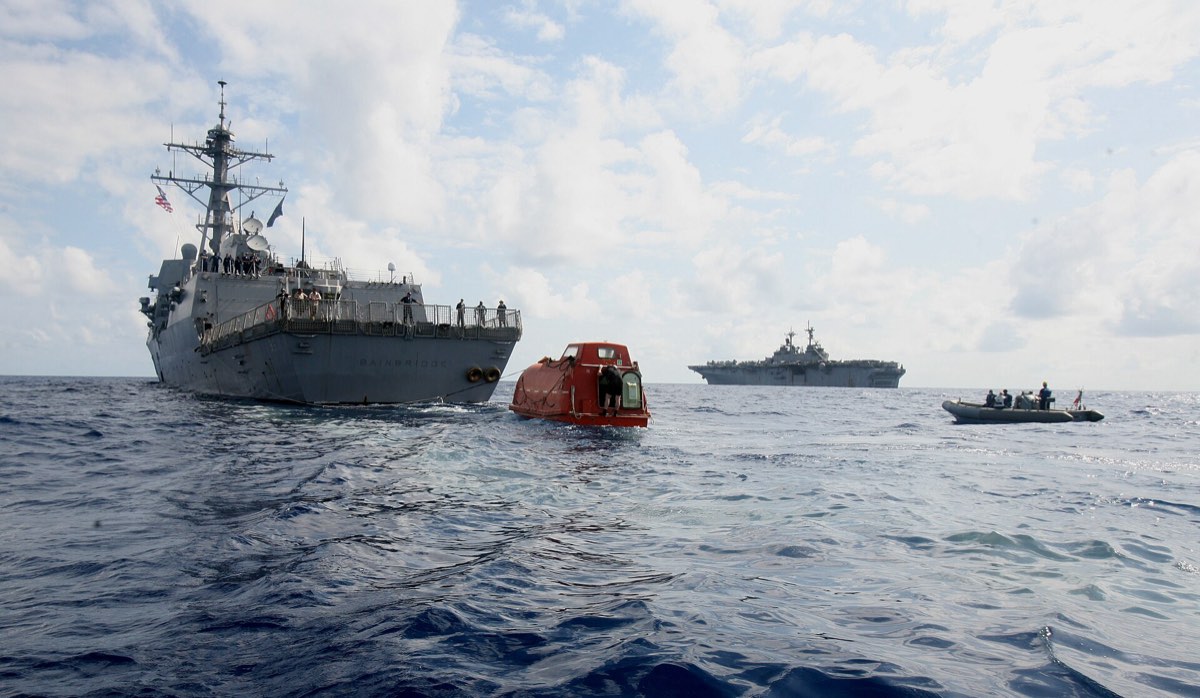
The Navy sent the Arleigh Burke-class destroyer USS Bainbridge and the frigate USS Halyburton on 8 April. Bainbridge had been commissioned in 2005 and took her name from Commodore William Bainbridge of the War of 1812.[1][28] She arrived early on 9 April, and her commanding officer, Frank Castellano, ran the talks alongside FBI negotiators.[1][10]
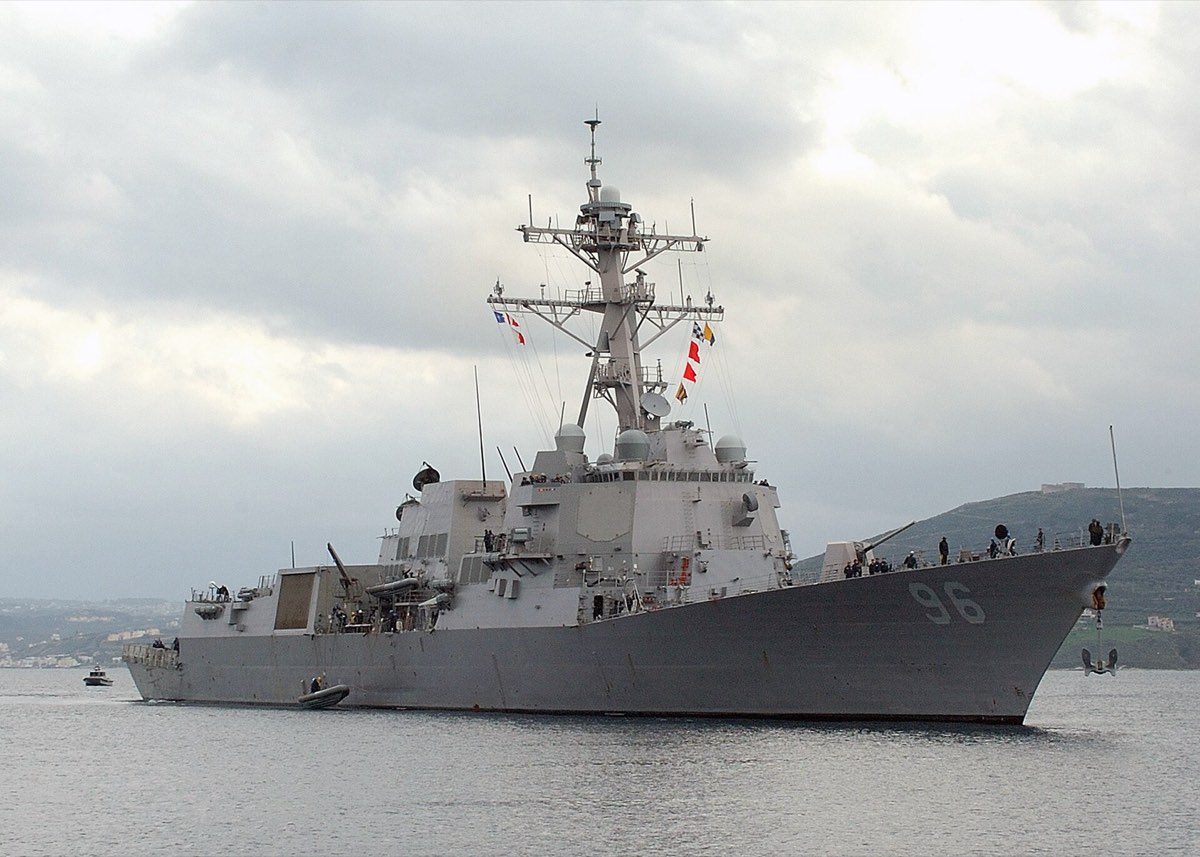
The warships stayed several hundred yards off, outside rifle range, with a ScanEagle drone and a P-3C Orion watching from above. The Maersk Alabama went on under escort, Aasheim took command again, and she reached Mombasa on 11 April, where the FBI secured her as a crime scene.[1] In the lifeboat the position was getting worse. The pirates were on a satellite phone to other groups, and four hijacked ships with 54 hostages were reported to be heading for the scene, the idea being to use them as shields and get Phillips ashore. They threw the phone and radio the Navy had dropped them into the sea.[1]
Shortly after sunrise on 11 April a pirate fired at Halyburton. She did not return fire and nobody was hurt, but the talks collapsed. The same day the lifeboat ran out of fuel and the wind rose. Castellano said his team calmed the pirates and persuaded them to accept a tow from Bainbridge.[1][10][12]
The SEAL Operation of 12 April
The SEAL team parachuted in on 11 April and was taken aboard. Snipers settled on the destroyer's fantail with the towed boat in their sights, waiting, the museum says, in heat above 100 °F.[10] President Obama had authorised force only if Phillips's life was in danger.[12]
12 April was Easter Sunday. Muse went across to Bainbridge that day, for treatment of his hand according to some sources and to negotiate ransom according to others.[1][9][12] The three left in the boat grew agitated, and towards evening a shot was fired inside. The Navy saw an AK-47 pointed at Phillips's back. Castellano gave the order and the snipers hit all three at once. Phillips was unhurt.[9][10][12] The sources differ slightly on who fired: the museum speaks of SEAL snipers, while Wikipedia adds an Air Force combat controller to two SEALs.[1][10]
Phillips said he thought at first he was caught in crossfire between pirate ships, and began to understand only when someone asked him in English if he was all right.[11] He went from Bainbridge to Kenya and flew home to Vermont on 17 April.[12] The lifeboat was taken to USS Boxer as evidence and later went to the museum.[1]
The Abduwali Muse Case
Muse was held in USS Boxer's brig and then flown to New York. The first fight was over his age, since no birth record existed. His mother said he was 16. His father gave 20 November 1993, which would have made him 15. His lawyers asked for juvenile treatment. A detective testified that Muse had said he was between 18 and 19, and on 21 April 2009 Magistrate Judge Andrew Peck ruled that he could be tried as an adult.[1][13]
A ten-count indictment followed on 19 May 2009, including piracy under the law of nations, a charge rooted in maritime law that carried a mandatory life term. Two more attacks from March and April 2009 were added in January 2010. On 18 May 2010 Muse pleaded guilty to hijacking, kidnapping and hostage-taking, the piracy count was dropped, and the agreed range was 27 to 33 years.[13]
On 16 February 2011 Judge Loretta Preska, citing deterrence, gave him 33 years and nine months and ordered $550,000 in restitution. The defence pointed to his youth and extreme poverty and asked for 27 years. Prosecutor Preet Bharara called him a hardened pirate leader who had pretended to shoot captives, and crewman Collin Wright asked for the heaviest sentence possible. Muse apologised and said smarter, more powerful people had led him astray.[13][14] Federal prison records give a projected release date of 30 May 2038.[13]
The Crew's Lawsuit and the Argument over the Film
The first suit came three weeks after the attack. Chief cook Richard Hicks sued Maersk Line Limited and Waterman in Houston in April 2009, saying that requests for armed security or barbed wire, raised at monthly meetings over three years, had been ignored. The companies did not comment.[15] Others followed in Texas from 2009, and on 9 April 2012 the cases were brought in Mobile, Alabama, and Norfolk, Virginia. The core claim was that the ship was warned to stay at least 600 miles off Somalia but went within about 250, with inadequate training and security.[16][17] Sources count nine to eleven plaintiffs, and press reports put the sum at $50 million.[1][17][18] The companies denied liability and argued over whether more security would have changed anything.[16][17]
The sources give different distances from the coast. Wikipedia puts the attack 240 nautical miles from Eyl, the plaintiffs say about 250 miles, and the legal scholar Jonathan Turley's blog reports Phillips saying at least 300.[1][17][20] In a 2010 CNN interview and a 2012 deposition Phillips acknowledged disregarding warnings to go farther out, while testifying that 600 miles would not have made the ship safe and that an attack was a matter of when.[17]
Captain Phillips opened on 11 October 2013 and widened the argument.[1] Unnamed crew members told the New York Post that Phillips was no leader of the kind shown on screen, that he had not followed the anti-piracy plan, and that the self-sacrifice in the film never happened.[19] The plaintiffs' lawyer, Brian Beckcom, said the true heroes were the Navy personnel.[17] Paul Barrett of Bloomberg wrote that Phillips's book had been promoted as showing him offering himself as a hostage, and that Phillips later acknowledged this came from erroneous media reports.[17]
The filmmakers held their ground. Director Paul Greengrass said in a Reddit session that he was 100% satisfied the film's account was authentic, including the captain's role, and was confident Phillips had not taken an irresponsible route. He accepted that compressing events into two hours may have lost some crew contributions.[18] He also said elsewhere that movies are not journalism.[17] Part of the criticism came from men seeking damages from the companies and part from crew speaking anonymously, and the suits did not name Phillips as a defendant.[17][19] According to the law firm that represented nine of the men, their cases ended in confidential settlements on the eve of trial in Mobile.[16] No court ever ruled on the captain's conduct.
Shipboard Security and the BMP Rules
After April the owners put a team of former military personnel on board. At about 06.30 on 18 November 2009, four pirates fired on the same ship with automatic weapons from about 300 yards. The team drove them off with evasive manoeuvres, small arms and a long-range acoustic device (LRAD). The master this time was Paul Rochford.[21] Similar approaches were turned away in 2010 and 2011. She was renamed in 2015 and has sailed as the Liberian-flagged Tygra since 2016.[2]
The industry's shared piracy guide, Best Management Practices (BMP), grew quickly over the same period. The second edition appeared in August 2009 and the third in June 2010, which extended the high risk area from Suez in the north to 10°S and 78°E.[22] In May 2011 IMO's resolution MSC.324(89) called for it to be implemented. BMP4 came in 2011 and BMP5 in 2018.[23][25]
BMP5 sorts its measures into layers. The first has lookouts, razor wire, manoeuvring, speed and freeboard (the height from the water to the deck), and armed guards. The second has door hardening, gates and cameras. The last has internal doors, the citadel and communications. A citadel is a compartment built to resist forced entry where all crew can muster, with food, water and sanitation, ideally satellite phone and VHF, and control of propulsion and steering if possible. The guide warns that military forces are likely to want all crew accounted for and two-way communication before they board.[24] What Perry did in 2009, cutting engine control and locking the crew below, is a rough early version of those paragraphs. Phillips being left outside is the risk they try to close.
On armed guards BMP5 stays neutral. It does not recommend their general use and leaves the decision to the operator, subject to flag state and coastal state permission, and it points companies to firms accredited to ISO 28007-1:2015.[24]
Citing no attacks on merchant ships off Somalia since 2018, the industry bodies removed the Indian Ocean High Risk Area on 1 January 2023, leaving the UKMTO voluntary reporting area unchanged.[26] In April 2025 the consolidated Best Management Practices Maritime Security (BMP MS) replaced BMP5.[25] The IMB's 2025 report records only a small number of incidents off Somalia, but says two in November far from shore show the groups can still operate at range. It credits naval presence, hardened ships and BMP for keeping a wider return in check.[27]
Frequently asked questions
Is Captain Phillips a true story?
Yes. Richard Phillips was held in a lifeboat for five days after Somali pirates boarded the Maersk Alabama on 8 April 2009, and SEAL snipers rescued him on 12 April. The outline is on the record, though part of the crew disputed the film's account of the captain's role and route.
Where is Abduwali Muse now?
He is serving 33 years and nine months in US federal prison. As of December 2025 he was recorded at FCI Cumberland, with a projected release date of 30 May 2038.
Why did the crew sue?
The plaintiffs said the ship was warned to stay at least 600 miles off Somalia but went within about 250, and that security was inadequate. The companies denied liability and the cases ended in confidential settlements before trial.
Sources
- Wikipedia. Maersk Alabama hijacking.
- Wikipedia. MV Tygra.
- Wikipedia. Richard Phillips (merchant mariner).
- ICC International Maritime Bureau. IMB reports a cluster of pirate attacks off the East Coast of Somalia, 31 March 2009.
- ICC International Maritime Bureau. 2009 worldwide piracy figures surpass 400.
- The World. Somali pirates' rise linked to illegal fishing and toxic dumping, 16 March 2012.
- D. Duda, T. Szubrycht. The Somali Piracy: New or Old Challenge for International Community. TransNav, vol. 3, no. 3, September 2009.
- History.com. Somali pirates hijack Maersk Alabama ship.
- Mel Allen. Captain Richard Phillips and the Pirates. Yankee Magazine, 19 February 2010.
- National Navy UDT-SEAL Museum. Maersk Alabama.
- NPR. Surviving a Somali Pirate Attack on the High Seas, 6 April 2010.
- Boston.com. 10 things that explain Captain Phillips's capture and journey home, 10 October 2013.
- Wikipedia. Abduwali Muse.
- Al Jazeera. Somali pirate gets 33 years in jail, 16 February 2011.
- Insurance Journal. Sailor Sues Owner, Crew Company of U.S. Ship Hijacked By Somali Pirates, 29 April 2009.
- VB Attorneys. Maersk Alabama and Somali pirates suit (plaintiffs' counsel case summary).
- Paul M. Barrett. Bloomberg article on the film and the crew lawsuits, republished by gCaptain, 12 October 2013.
- TheWrap. Paul Greengrass Stands Behind 'Captain Phillips' Accuracy, 18 October 2013.
- SlashFilm. Captain Phillips' Crew Questions Movie's Authenticity, October 2013.
- Jonathan Turley. "Capitan Phillips": Crew Members Denounce Film As A False Account, 14 October 2013.
- Fox News. Somali Pirates Attack U.S.-Flagged Ship for Second Time, November 2009.
- West P&I. Piracy Update: Best Management Practices Version 3, 9 July 2010.
- West P&I. Piracy: Best Management Practices Version 5, 3 July 2018.
- BIMCO, ICS, IGP&I Clubs, INTERTANKO, OCIMF. BMP5: Best Management Practices to Deter Piracy and Enhance Maritime Security, 2018.
- IMO. MSC.1/Circ.1601/Rev.2, Revised Industry Counter Piracy Guidance, 30 June 2025.
- Hellenic Shipping News. Shipping industry to remove the Indian Ocean High Risk Area, 23 August 2022.
- ICC International Maritime Bureau. Global maritime piracy and armed robbery increased in 2025, 15 January 2026.
- Wikipedia. USS Bainbridge (DDG-96).